
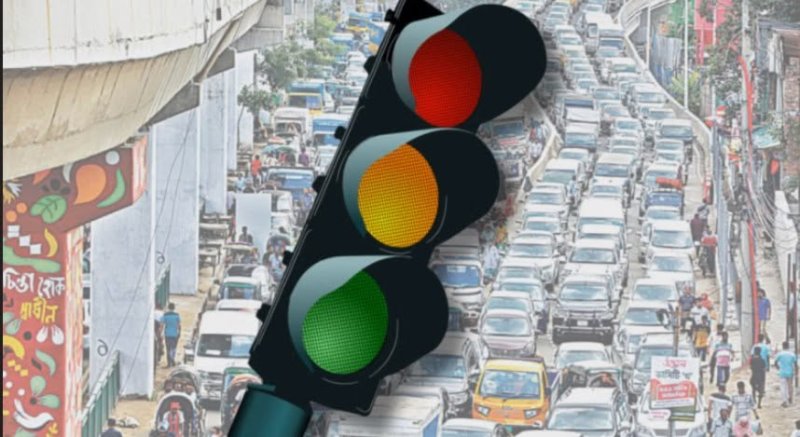

Dhaka is taking another step towards technology-supported traffic management through a locally designed, semi-automatic traffic signalling system developed with technical support from the Bangladesh University of Engineering and Technology (BUET). The initiative aims to make vehicle movement more orderly at busy intersections by combining programmed signal timings with the ability for traffic police to intervene when road conditions require it.
The project is coordinated by the Dhaka Transport Coordination Authority (DTCA), with installation and related responsibilities shared by Dhaka North City Corporation (DNCC) and Dhaka South City Corporation (DSCC). The Dhaka Metropolitan Police (DMP) plays an important role in operating and supervising traffic at the intersections. Rather than relying entirely on imported equipment or manual hand signals, the initiative uses a locally adapted approach intended to suit Dhaka’s complex and often unpredictable traffic conditions.
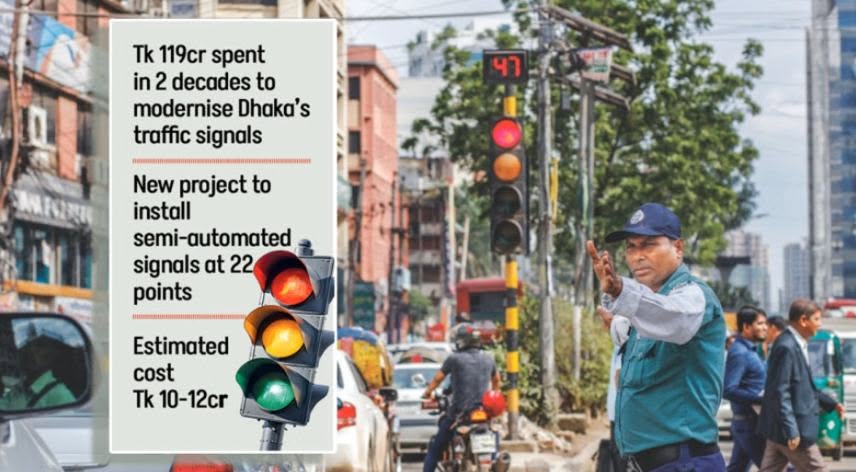 A traffic-signal installation associated with Dhaka’s efforts to improve intersection management.
How the Semi-Automatic System Works
The system is designed to operate in two modes. In automatic mode, traffic lights run on pre-set signal cycles, with timings that can be planned for peak and off-peak periods. In manual mode, traffic personnel can control or override the lights when congestion, an incident, a special movement or another unusual situation makes the programmed cycle unsuitable. Control equipment is placed in or near traffic-police booths so that officers can manage the signals without relying only on hand gestures.
This hybrid arrangement is important in Dhaka, where traffic volumes can vary sharply within a short period and where buses, cars, motorcycles, rickshaws and other vehicles often compete for limited road space. A signal cycle can help assign right-of-way more consistently, while the manual option gives traffic police flexibility when actual road conditions differ from the planned schedule.
- Dual-mode operation: Programmable automatic signal cycles can be supplemented by manual control from traffic personnel.
- More predictable movement: Clear red, amber and green phases—and countdown displays where installed—can make waiting and crossing decisions easier for road users.
- Local technical support: BUET’s engineering involvement helps tailor the design to local road conditions and implementation needs.
- Monitoring and communication equipment: Traffic-signal installations have also been photographed with CCTV cameras and loudspeakers. However, the presence and function of specific equipment may vary by site.
The Initial 22-Intersection Programme
The initial programme envisaged traffic signals at 22 intersections along the corridor between the High Court area and the airport. DNCC was assigned responsibility for 14 locations, while DSCC was responsible for eight. The first phase was intended to test the system, build familiarity with signal-based traffic control and inform a wider rollout.
The pilot was inaugurated on 30 August 2025 at seven intersections: Hotel InterContinental, Banglamotor, Sonargaon (Karwan Bazar), Farmgate, Bijoy Sarani, the Chief Adviser’s Office and Jahangir Gate. Officials presented the pilot as a practical step towards restoring the use of traffic signals on major roads after years in which traffic at many intersections was managed largely by police officers directing vehicles manually.
Implementation Progress and Expansion Plans
Implementation has proceeded in stages rather than all 22 signals becoming operational at once. A report published in March 2026 said five additional intersections had become operational on an experimental basis after the initial seven-site launch, bringing the reported total to 12. The report also noted that delays—including procurement, administrative and site-preparation issues—had slowed the wider rollout.
In July 2026, the DMP said it planned to extend semi-automatic signals to 120 major intersections across Dhaka within six months. Separately, DSCC launched a trial automated traffic signal system at Shahbagh in August 2026 and announced plans to expand modern signals to additional key intersections. These announcements indicate a broader effort to modernise traffic control, but planned locations should not be treated as already operational: the 22-intersection corridor, subsequent city-corporation initiatives and the wider 120-intersection target represent different stages and scopes of work.
Traffic Signals and AI-Based Enforcement
Signal operation is also being complemented by a separate, technology-based traffic-enforcement programme. In June 2026, The Business Standard reported that AI-powered cameras were operating at 19 major intersections and that the DMP had filed around 1,500 traffic cases through the system by that point. The cameras were being used to help detect violations and support enforcement, including offences related to signal compliance and unsafe road behaviour.
These AI enforcement cameras should not be confused with the semi-automatic signal controller itself. The signal system determines or manages the right-of-way at an intersection; enforcement technology monitors road-user behaviour and can help authorities act on violations. Used together with effective traffic policing, the two approaches may support a more consistent traffic-management system.
What the System Could Improve
A functioning signal system can help organise movements through a junction, reduce uncertainty about when vehicles should proceed and create clearer opportunities for pedestrians to cross. Coordinated signal timings may also reduce unnecessary stopping and improve the use of available green time. For traffic police, reliable signal control could reduce the need to direct every movement manually, allowing officers to focus on incidents, violations and locations where intervention is still necessary.
The benefits, however, depend on how the signals work in real traffic conditions. Reporting from Dhaka’s pilot intersections has described some improvement in order and vehicle movement, while also noting that officers still need to intervene when drivers ignore red lights, vehicles stop inappropriately or buses block intersections while picking up passengers. The available reporting does not establish that the system has eliminated congestion citywide.
Why Technology Alone Is Not Enough
Dhaka’s congestion is influenced by more than signal timing. Illegal parking, roadside obstructions, unregulated stopping, weak lane discipline, pedestrian crossings outside designated areas and inconsistent compliance with traffic rules can all reduce the effectiveness of a signal. A green light cannot move traffic through a junction if the road ahead is blocked.
To realise the system’s potential, the rollout needs to be supported by:
- Consistent enforcement: Drivers and motorcyclists must obey signal phases, stop lines and designated lanes.
- Safer pedestrian movement: Zebra crossings, footbridges and other appropriate crossing facilities should be kept accessible, with efforts to discourage unsafe road crossing.
- Better bus operations: Buses should stop at designated stops and avoid occupying junctions or blocking lanes while boarding and dropping off passengers.
- Clear intersections: Illegal parking, roadside encroachment and other obstructions should be removed from critical traffic areas.
- Maintenance and coordination: Signal equipment needs regular maintenance, while DTCA, the city corporations, BUET and DMP must coordinate implementation and day-to-day operation.
A Practical Step Towards Smarter Urban Mobility
Dhaka’s BUET-supported semi-automatic signalling initiative represents a practical effort to make intersection management more systematic using locally adapted technology. Its combination of pre-programmed timings and manual intervention recognises the need to balance consistent signal operation with the realities of traffic on the ground.
The project’s longer-term value will depend on completing planned installations, maintaining the equipment and ensuring that road users follow the signals. When combined with effective enforcement, disciplined public transport operations, pedestrian-friendly infrastructure and clearer intersections, modern traffic signalling can become one useful part of a broader strategy for safer and more efficient urban mobility in Dhaka.
Sources and Further Reading
- The Daily Star — Dhaka city getting semi-automatic traffic signals (initial 22-intersection programme and pilot design).
- The Daily Star — Pilot project shows promise, but delays stall wider rollout (reported progress and implementation challenges, March 2026).
- Bangladesh Sangbad Sangstha (BSS) — DMP plans semi-automatic traffic signals at 120 intersections in 6 months (expansion target reported in July 2026).
- The Daily Star — Automated traffic signal system debuts at Dhaka’s Shahbagh (DSCC trial and further expansion plans, August 2026).
- The Business Standard — AI-run traffic cameras now at 19 Dhaka intersections (AI-based enforcement update, June 2026).
- The Financial Express — New traffic signal system (photographic report on signal equipment installed in Karwan Bazar, April 2025).